From Customers to Ambassadors: How to Get Your Customers to Bring You More Customers
Acquiring a new customer costs 5 times more than retaining an existing one. Yet most companies spend 90% of their marketing budget on acquisition and almost nothing on retention. This pillar seeks to rebalance that equation.
The Problem: The Silent Leakage of Income
Many companies are so obsessed with acquisition that they neglect retention, losing customers (and money) without even realising it. The statistics are stark:
65%
Of customers are lost due to lack of after-sales follow-up - Source: Bain & Company, 2023. They don't leave because your product is bad. They leave because no one called them after the first purchase.
5x
It is more expensive to acquire a new customer than to retain an existing one - Source: Harvard Business Review, 2014. If you lose a customer worth €3,000/year, you don't lose €3,000 - you lose the €3,000 plus the €15,000 it cost you to get them.
80%
Of future revenues come from the 20% of your most loyal customers - Source: Gartner, 2023. Do you know who these 20% are in your business? Are you treating them differently?
The Solution: A System of Loyalty and Recurrent Growth
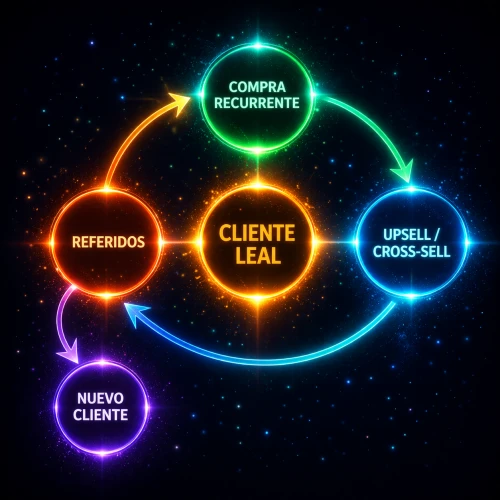
We build a system that keeps your customers coming back, spending more and bringing others. Because acquiring a new customer costs 5 times more than retaining one you already have.
1. Structured Onboarding (First 90 Days)
40% of the customers who leave, leave within the first 90 days. Not because of the product - because of the lack of support. We design the process that turns the first experience into the reason to stay.
Days 1-30: Adoption and First Victories
- Personalised welcome (email, phone call or video from the team).
- Guided configuration and step-by-step tutorial.
- Identification of a "quick win" to generate immediate satisfaction.
- Check-in on day 7 and 21 to resolve doubts.
Days 31-60: Habit and Value Discovery
- Introduction of advanced functionalities.
- Educational content (webinars, tutorials) to maximise usage.
- Measurement of engagement and use of the product/service.
Days 61-90: Request for testimonials and success stories - when the client has already seen results, the 70% accepts.
- Identification of upsell or cross-sell opportunities.
- Request for testimonials and success stories.
- Invitation to referral programme.
2. Proactive Support and Levels of Care
Reactive support puts out fires. Proactive support prevents them from happening. We monitor your customer satisfaction and act before the problem reaches you.
Level 1: Self-service (Knowledge Base, Chatbot):
For quick and frequent consultations, available 24/7.
Level 2: Support by Email/Ticket (Response in <24h):
For more complex questions that require investigation.
Level 3: VIP Support (WhatsApp/Phone, Dedicated Agent):
For high value customers, with response in <2 hours.
3. Loyalty Programmes That Work
A well-designed loyalty programme increases LTV by 25-95%. A poorly designed one (expiring points, unattainable rewards) does exactly the opposite.
Points can be accumulated and redeemed:
For each purchase, the customer accumulates points that can be redeemed for discounts, premium products or services.
Referral Programme:
The referring customer and the new customer receive a 20% discount. Referrals convert 4x more than any other acquisition channel.
Gamification:
Exclusive badges, levels (Bronze, Silver, Gold, Platinum) and rewards to motivate continued use.
Exclusive Access:
Content, events or products available only to loyal customers.
4. Continuous and Personalised Communication
The difference between an email that gets opened and one that goes to spam is not frequency - it's relevance. Every communication has a specific purpose for the customer, not for the company.
Monthly Newsletter:
With tips, news and success stories (valuable content, not just promotions).
Anniversary Emails:
We celebrate the customer's anniversary with the brand (with a discount or gift).
Satisfaction Surveys (NPS):
We measure satisfaction and act on feedback.
Reactivation of Inactive Clients:
We detect customers who have not purchased in 60-90 days and launch a reactivation sequence. The 15-20% comes back with the right incentive.
Who Needs to Improve their Loyalty Strategy?
Loyalty is critical to:
If your product is consumed or needs replenishment, loyalty multiplies LTV.
If you lose more than 30% of your customers per year, you are losing money you already invested in acquiring them.
Services Businesses (SaaS, Subscriptions): Where growth depends on retention, not just acquisition.
Frequently Asked Questions on Loyalty
What is a good retention rate?
It depends on the sector. In SaaS, a retention of 90-95% per year is excellent. In e-commerce, a recurring purchase rate of 30-40% is very good. If you are below 20%, there is a lot of room for improvement.
Do points programmes really work?
Yes, but only if they are well designed. Points should be easy to accumulate and redeem, and rewards should be attractive. A poorly designed programme (expiring points, unattainable rewards) can have the opposite effect.
How can I measure customer satisfaction?
We use the Net Promoter Score (NPS), a simple metric that asks: «Would you recommend our company to a friend» (0-10). Customers who answer 9-10 are promoters, 7-8 are passive, and 0-6 are detractors. A positive NPS indicates a healthy customer base.
What do I do with inactive customers?
First, identify why they left (exit survey). Then, launch a reactivation campaign with an incentive. If they do not respond, focus resources on active customers.
Stop constantly chasing new customers and start maximising the value of the ones you already have. We build the system that turns every customer into a recurring asset and an ambassador for your brand. Proposed: «Apply for your Free Audit and you we show you how to increase your LTV and reduce your churn in the next 90 days
 Español
  English (UK)
 Português do Brasil
 Português

